

the situation
Digital demand was accelerating, but capability was uneven: IT professionals building products needed deeper craft skills; business partners embedded in squads needed shared ways of working; leaders needed the language (and airtime expectations) to sponsor and protect capacity for squad work. At the same time, the organization needed a practical way to identify critical skill gaps, prioritize investment, and internalize expertise so digital delivery could scale beyond a single centralized team.
the IDEA
Treat enablement as a delivery accelerator. Build a single, repeatable model that connects:
- A common skills taxonomy (capabilities, proficiency levels, and target audiences)
- Capability measurement (self-assessment to make gaps visible and comparable)
- A curriculum and learning ecosystem (on-demand tracks, cohort programs, certifications, and SME-led learning)
- Change and leader activation (campaigning, leader kits, and participation pathways)
So product delivery could scale with internal talent, not external dependency.
the solution
Digital transformation doesn’t scale through one-off trainings. It scales when people can find the right path for their role, and have support when they hit real friction. We launched a connected enablement system that made digital capability measurable, teachable, and usable in day-to-day delivery, from baseline literacy to deep specialist certification, with leaders and SMEs reinforcing the work in the flow of operations.
- A digital competency map generated by a self-assessment tool to baseline skills and focus investment (by role, skill, and level).
- A comprehensive learning portfolio (8 macro-themes, 20+ courses) aligned to priority digital capabilities.
- Role-based learning ecosystem spanning core innovation skills and specialist paths (e.g., agile, product, design, change), blending:
- Self-paced learning for broad scale
- Instructor-led training for deeper capability building
- Communities of practice to sustain adoption through peer learning and reuse
- Cohort-based certifications to build depth where digital delivery needed it most (e.g., Scrum Masters; Product Managers).
- A “find-an-expert” support model (SME locator + self-service enablement hub) to reduce bottlenecks and speed learning-in-the-flow-of-work.
- Change activation for adoption (leader enablement, campaigns, and engagement actions to pull participation into the transformation).






what i did
- Owned the enterprise digital enablement strategy to internalize “future-of-work” capabilities and support digital transformation with a repeatable operating approach.
- Developed an internal digital SME bench, designing strategic upskilling/certification pathways to build, retain, and mobilize in-house expertise needed for transformation delivery.
- Owned the digital enablement strategy and operating model, translating transformation demand into a scalable capability-building program (skills → measurement → curriculum → adoption).
- Built the competency framework and measurement approach, operationalizing a competency map + self-assessment to create visibility into skill distribution and investment priorities.
- Designed the curriculum architecture and learning pathways, aligning a course portfolio to priority capabilities and proficiency levels (including a catalog structure that could scale).
- Developed and launched training assets and cohort experiences (including foundational training builds and certification pathways that supported squads and delivery roles).
- Internalized missing digital skills by upskilling strategic SMEs, investing in targeted training so expertise could be built and retained internally—and then converted into scalable learning tracks for the broader organization.
- Built the change adoption layer (leader activation, messaging, campaigns, and participation pathways) so learning translated into new ways of working, not isolated course completion.
- Defined and tracked program adoption metrics across the enablement ecosystem (participation, community engagement, and learning reach) to inform iteration and where to deepen capability next.
- Used discovery and feedback loops to iterate and refine learning journeys, content, and engagement.
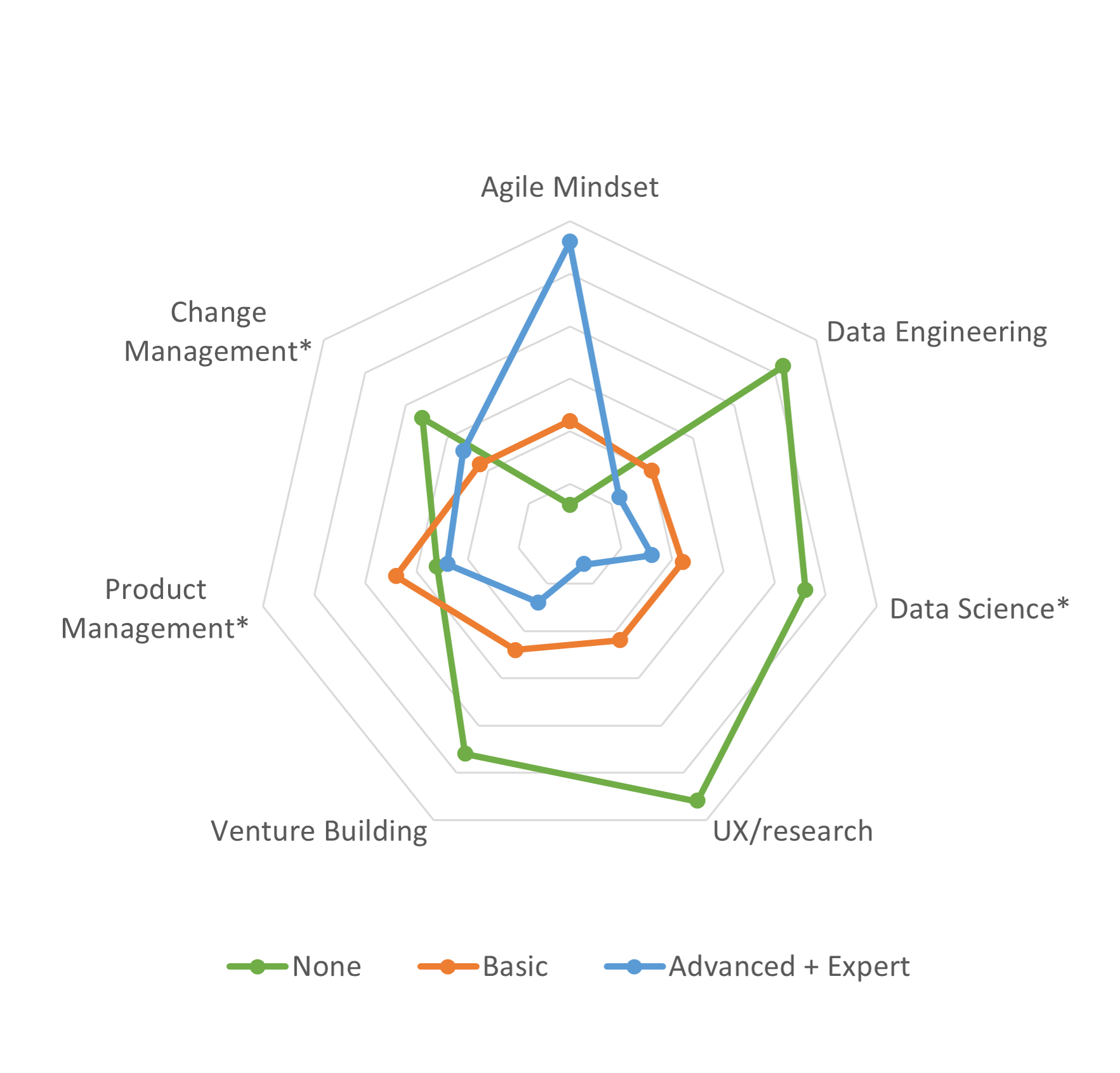
Competency map snapshot
(self-assessment)
A view of how capability is distributed across priority digital skills and proficiency levels. Used to pinpoint where the organization has coverage, where it has “single-point-of-failure” risk, and where to focus upskilling investment to staff product squads and delivery roles.
why it mattered
Digital transformation isn’t limited by lack of good ideas or problems to solve. It’s limited by resources: do we have enough people who can work in product squads, build solutions, and lead change without slowing down or creating new risk?
This enablement strategy closed that gap by building a repeatable system for digital skills across three layers: builders (IT/digital roles), business product partners, and leaders who had to sponsor time, priorities, and adoption.
In other words, it didn’t just “train people.” It increased the organization’s ability to deliver and scale digital products by creating shared methods, role-based pathways, and a community layer that kept learning connected to real work.
Digital transformation results in 2023 included:
- 59 digital products delivered (portfolio outcome)
- 200+ areas impacted (enterprise reach)
- $130M USD captured value reported for the portfolio (an increase of 40% compared to the previous year)
Enablement numbers in 2023 included:
- Self-paced learning: 691 enrolled; 252 completions
- Instructor-led training: 1,204 people trained across 9 courses (including Agile, Change Management, Product Management, and Design)
- 3,533 members across 10 communities of practice
- Content reach: 561 publications; 93,000 views; 9,292 reactions (knowledge-sharing and practice signals)

 Cinthia Blanchard
Leave a comment